
 All vikis
 Aion 2
 Ananta
 ARC Raiders
 ArcheAge Chronicles
 Call of Duty: Modern Warfare 4
 Chrono Odyssey
 Civilization 3
 Civilization 4
 Crimson Desert
 Deadlock
 Diablo 4
 Diablo 5
 Enshrouded
 Fable
 Final Fantasy Resonance
 Football Manager 27
 Grand Theft Auto 6
 Heroes of Might and Magic 3
 Heroes of Might and Magic: Olden Era
 Kingdom Come: Deliverance 2
 Path of Exile 2
 Phantom Blade Zero
 Probably Stolen
 Slay the Spire 2
Tomb Raider (1996)
Tomb Raider (1996) is the first Tomb Raider game, made by Core Design in Derby and published by Eidos Interactive in late 1996 on Sega Saturn, PlayStation and PC. Lara Croft hunts the Scion across 15 levels in Peru, Greece, Egypt and Atlantis; it sold over 7 million copies.
Tomb Raider (1996) is the game that introduced Lara Croft: a third-person action-adventure by Core Design of Derby, England, published by Eidos Interactive, that came out first on the Sega Saturn in October 1996, then on PlayStation and PC (DOS) in November. Hired by Jacqueline Natla, Lara hunts the three pieces of an Atlantean artifact, The Scion, through 15 levels in Peru, Greece, Egypt and Atlantis, solving block-by-block jumping puzzles in tombs with no map, markers or hints, and fighting wolves, a Tyrannosaurus rex, mummies and Natla's mutants. Eidos budgeted for 100,000 copies; Ian Livingstone said it went on to sell over seven million. Crystal Dynamics has remade it twice, as Tomb Raider: Anniversary (2007) and Tomb Raider: Legacy of Atlantis, out Feb 12, 2027.
Quick facts
| Get it | Tomb Raider I on Steam, or in Tomb Raider I-III Remastered |
| Developer | Core Design, Derby, England |
| Publisher | Eidos Interactive |
| Created by | Toby Gard and the Core Design team |
| First release | Sega Saturn, October 1996 (day disputed) |
| Then | PlayStation and PC (DOS), November 1996 |
| Later | Windows and Mac "Gold" edition (1998), Steam (Nov 28, 2012), iOS (Dec 17, 2013), Remastered (Feb 14, 2024) |
| Levels | 15, plus Lara's Home (training) |
| Expansion | Unfinished Business, 4 levels |
| Metacritic | 91 (PlayStation, 13 critics), as of Nov 2, 2026 |
| Sales | Over 7 million (Eidos' Ian Livingstone) |
| Remakes | Tomb Raider: Anniversary (2007), Legacy of Atlantis (Feb 12, 2027) |
Sources: Metacritic, read Nov 2, 2026; PC Gamer (Nick Thorpe, Darran Jones), Apr 13, 2018; Steam: Tomb Raider I; The Verge, Dec 17, 2013; Stella's Tomb Raider Site.
When did Tomb Raider come out?
The Sega Saturn version came first, in October 1996, because late in development Core's boss Jeremy Heath-Smith struck a deal with Sega to put it out ahead of the PC and PlayStation, which meant delivering the finished game six weeks early. The exact Saturn day is disputed. GameSpot's game page gives Oct 31, 1996; Crystal Dynamics celebrated the 27th anniversary on Oct 25, 2023, which implies Oct 25, 1996; and PC Gamer's history says only October. Metacritic dates the PlayStation version Nov 15, 1996. The 30th anniversary fell in October 2026.
Later releases: a "Gold" edition for Windows, and the first for the Mac, came in 1998 with the two extra adventures of Unfinished Business; the PC version reached Steam as Tomb Raider I on Nov 28, 2012; and the original came to iOS for 99 cents on Dec 17, 2013, unedited. Aspyr's Tomb Raider I-III Remastered, on Feb 14, 2024, put it on current consoles and PC with its sequels.
Who made Tomb Raider?
Core Design was a studio of around 25 people in a converted Victorian house on Derby's Ashbourne Road in 1994, making 2D games. Heath-Smith asked for 3D ideas that would suit the PlayStation, and Toby Gard, who had designed BC Racers, pitched a third-person game about raiding tombs under pyramids. Accounts of the origins differ, but Eurogamer says everyone agrees Gard created Lara and the idea of the game. GameSpot and Game Developer, in 2004, credited Gard and Paul Douglas together.
The first team was six people: Gard, programmers Paul Douglas, Gavin Rummery and Jason Gosling, level designer Heather Stevens (née Gibson, from Rare) and artist and level builder Neal Boyd. Rummery built the room editor the levels were made in. Nathan McCree wrote the music in about three weeks, and artist Stuart Atkinson joined about four months from the deadline to help with enemies. Ian Livingstone was then head of Eidos.
How Lara Croft was created
Lara began as Laura Cruz, a South American adventurer, then became a British archaeologist, Lara Cruz, and finally Lara Croft. Her arched eyebrows and long braid were already in Gard's Laura Cruz designs, though the braid was cut from the first game because it did not work with her acrobatics; Rummery got it working for Tomb Raider 2. Some colleagues remember early prototypes with an Indiana Jones-style man, which worried Core's bosses about a lawsuit; others say Gard always planned a woman. Rummery recalled Gard wanting Lara to be "this kind of ice queen". The Strong museum says the designers drew on Raiders of the Lost Ark, Prince of Persia and the discovery of Tutankhamun's tomb. Gard animated her and slipped in her handstand without telling the team, to see if they would find it. The 1996 Lara was built with about 300 polygons.
Who voiced Lara in 1996 is not confirmed by a source this viki uses; see Lara Croft Voice Actors.
Development: the grid
Rummery called the breakthrough "the decision to build everything on a grid": it let Gard define Lara's moves, Douglas make the controls work and Rummery build an editor for Boyd and Stevens, who had first tried to build levels in a wireframe-only 3D program. On that grid Lara stood three-quarters of a block high, could jump up and grab a block and a half, and could make a run-and-grab jump over four blocks. The controls, later called "tank controls," turned Lara in place and ran her forward, so players could calculate every jump; speedrunners still use them.
The team worked without a design document it kept to, and the game "had to come out for Christmas 1996". The end was crunch: testers brought bug lists through the night and builds were burned to CD again and again. It showed strongly at E3 1996, and at ECTS Eidos had three models dress as Lara. For the launch Eidos flew magazine editors to Egypt; the developers stayed behind doing translations.
Story
In the game's lore Atlantis was ruled by three, Natla, Qualopec and Tihocan, each entrusted with a piece of the Scion. Natla stole the others and used the Scion to breed mutants to overthrow them, so Qualopec and Tihocan sealed her in a cryonic chamber. Qualopec was entombed in Vilcabamba in Peru, Tihocan under St. Francis' Folly in Greece, and Natla's piece was hidden in the City of Khamoon in Egypt. The 1945 Trinity atomic test freed her, and she became Jacqueline Natla, head of Natla Technologies.
The game opens with Natla hiring Lara to recover the Scion from Vilcabamba. After Lara takes Qualopec's piece, Natla's henchman Larson ambushes her and, beaten, "reveals more than he should". Lara breaks into Natla Technologies, finds a 1573 prayer book pointing to Tihocan's tomb, and fights through Greece against the second henchman, Pierre DuPont, until he dies in the tomb. In Egypt she beats Larson again and takes the last piece, then follows Natla to Atlantis, where she destroys the Scion, defeats Natla, and escapes the exploding Great Pyramid. Anniversary's executive producer later called this story "pretty sparse". The cast is on Tomb Raider Characters. Josh Strife Plays' clips on this page show the 1996 PlayStation version.
Levels
The 15 levels run in a fixed order, with Lara's Home as a training level from the main menu. The full table, with secrets, is on Tomb Raider Levels.
| Region | Levels |
|---|---|
| Peru | Caves, City of Vilcabamba, The Lost Valley, Tomb of Qualopec |
| Greece | St. Francis' Folly, Colosseum, Palace Midas, Cistern, Tomb of Tihocan |
| Egypt | City of Khamoon, Obelisk of Khamoon, Sanctuary of the Scion |
| Atlantis | Natla's Mines, Atlantis, The Great Pyramid |
Source: Stella's Tomb Raider Site.
Gameplay
Lara runs, jumps, climbs, grabs ledges, shimmies, swims and dives, with every distance measured in grid squares: a standing jump covers about one, a running jump about two, by Stella's description. Walk stops her stepping off edges. The game has no pointers, objective markers, hints or documents: levels are puzzles of levers, keys, movable blocks that move only in fixed grid steps, traps, boulders and timed doors. There are no vehicles; those arrive in Tomb Raider 2.
Her dual pistols have unlimited ammunition; the shotgun, magnums and Uzis need ammunition found in the levels. Enemies are mostly animals, from bats and wolves to lions, gorillas, crocodiles, raptors and one T. rex, then mummies, centaurs and Atlantean mutants, and a few people: Larson, Pierre, three of Natla's men in the mines, and Natla. Each level hides 1 to 5 secrets with ammunition or medi packs. On PC Lara saves anywhere; on PlayStation and Saturn she must collect a save crystal for each save. More on Controls and Movement, Weapons, Enemies and Secrets.
Reviews
| Outlet | Version | Score |
|---|---|---|
| Metacritic (13 critics) | PlayStation | 91, "Universal Acclaim" |
| Metacritic users (551 ratings) | PlayStation | 8.2 |
| Game Revolution | PlayStation | 100 |
| GameSpot (Hugh Sterbakov, Dec 9, 1996) | PlayStation | 8.5 |
| GameSpot (Ryan MacDonald) | Saturn | 7.9 |
| Steam users (1,863 reviews) | PC, Tomb Raider I | 83% positive |
Sources: Metacritic, read Nov 2, 2026; GameSpot PlayStation review; GameSpot Saturn review; Steam. Scores as of Nov 2, 2026.
GameSpot's Sterbakov called it "the new benchmark for 32-bit 3-D gaming", comparing it favorably with Super Mario 64, and faulted only some camera angles and animals that "seem to be on a polygon fast." Game Revolution said it looked like a 64-bit game on a 32-bit machine. GameSpot's Saturn review found that version less sharp than the PlayStation one and called the game the closest thing yet to a "Mario 64 killer".
Sales and legacy
Eidos planned for 100,000 copies; Livingstone said the game sold over seven million, and Eurogamer puts it at 7.5 million. No per-platform figures are published. Core's staff, on royalty contracts, got first checks of around £30,000 each. Lara became a celebrity beyond games: she was on the cover of The Face and advertised Lucozade before Tomb Raider 2, and Eurogamer notes the game found a female audience, "unprecedented for video games at the time." The Strong inducted it into the World Video Game Hall of Fame in 2018, and the series has passed 100 million copies (Guinness, Oct 11, 2024); see Tomb Raider Sales.
Gard and Douglas left Core soon after the release, unhappy with Eidos marketing Lara as a sex symbol and wanting more creative freedom; Gard was 24 and walked away from royalties to found Confounding Factor. Core made a sequel a year for the PlayStation era, and Eidos moved the series to Crystal Dynamics after The Angel of Darkness (2003). Gard rejoined at Crystal Dynamics in August 2004. Derby named a street Lara Croft Way in July 2010. The full order of games is on Tomb Raider Games in Order.
Unfinished Business
The 1998 Gold edition added two expert adventures, now sold together as Unfinished Business: Shadow of the Cat, back to Khamoon for a tomb of the cat goddess Bastet, and Unfinished Business, back to Atlantis to destroy the mutants. Their four levels are Return to Egypt, Temple of the Cat, Atlantean Stronghold and The Hive. They reached consoles for the first time in Tomb Raider I-III Remastered, which plays the Atlantis pair first.
Remakes and remasters
Tomb Raider: Anniversary (Crystal Dynamics, Jun 5, 2007) rebuilt the game for its 10th anniversary "from the ground up" in the Tomb Raider: Legend engine, with Legend's moves, all-new level content and a fuller story. GameSpot called it "the best Tomb Raider game in years," but it sold 1.3 million, the series' lowest. Core Design had once wanted to remake the 1996 game itself; see Tomb Raider: Anniversary.
Tomb Raider I-III Remastered (Aspyr, Feb 14, 2024) keeps Core's original code and levels, adds new graphics that switch back to the 1996 look at any time, modern controls, achievements and photo mode, and includes Unfinished Business. Its boot screen warns of "offensive depictions of people and cultures" left unaltered. See Tomb Raider I-III Remastered.
Tomb Raider: Legacy of Atlantis (Crystal Dynamics and Flying Wild Hog, published by Amazon Game Studios, Feb 12, 2027) is a full reimagining in Unreal Engine 5 that follows the same Scion hunt through Peru, Greece, Egypt and a Mediterranean island, with semi-connected spaces, a grapple, crafting and a skill tree. It is unreleased: what is known comes from the makers and pre-release previews. See Tomb Raider: Legacy of Atlantis, What's New in Legacy of Atlantis and Legacy of Atlantis Release Date. The clip is IGN's Jun 2026 first preview, from a pre-release build.
Frequently asked questions
When did Tomb Raider 1 come out? The 1996 Tomb Raider came out on Sega Saturn in October 1996 (the day is disputed: Oct 25 and Oct 31 are both given) and on PlayStation and PC in November 1996; Metacritic dates the PlayStation version Nov 15, 1996.
Who made the original Tomb Raider? Core Design, a studio in Derby, England, made it and Eidos Interactive published it. Toby Gard created Lara Croft and the idea, with a first team of six.
How many copies did Tomb Raider 1 sell? Over seven million, according to Eidos' Ian Livingstone; Eurogamer puts it at 7.5 million. Eidos had planned for 100,000.
How many levels are in the original Tomb Raider? Fifteen, across Peru, Greece, Egypt and Atlantis, plus the Lara's Home training level. Unfinished Business adds four.
Is the original Tomb Raider still good? Critics rated it 91 on Metacritic for PlayStation as of Nov 2, 2026, and 83% of Steam user reviews of Tomb Raider I are positive. Its tank controls and grid-based jumps feel old; Tomb Raider I-III Remastered adds modern controls.
What is the best way to play Tomb Raider 1 today? Tomb Raider I-III Remastered (2024), on PC, PlayStation, Xbox, Switch, Switch 2 and mobile, includes the 1996 game and Unfinished Business. See Where to Start with Tomb Raider.
Is Legacy of Atlantis a remake of Tomb Raider 1? Yes. Tomb Raider: Legacy of Atlantis, out Feb 12, 2027, is a full reimagining of the 1996 game, the second remake after Tomb Raider: Anniversary (2007).
Sources
- The history of Tomb Raider, PC Gamer (Nick Thorpe, Darran Jones), Apr 13, 2018
- 20 years on, the Tomb Raider story told by the people who were there, Eurogamer (Wesley Yin-Poole), Oct 30, 2016
- Tomb Raider (1996) Reviews, Metacritic, read Nov 2, 2026
- Tomb Raider (1996), GameSpot, undated game page
- Tomb Raider Review, GameSpot (Hugh Sterbakov), Dec 9, 1996
- Tomb Raider Review (Saturn), GameSpot (Ryan MacDonald), page dated May 2, 2000
- Tomb Raider I, Steam, read Nov 2, 2026
- Original 'Tomb Raider' launches on iOS for 99 cents, The Verge (Chris Welch), Dec 17, 2013
- Tomb Raider, The Strong National Museum of Play, read Nov 2, 2026
- 30 Years Of Lara Croft: A Look At The Tomb Raider's Evolution, GameSpot (Kevin Wong), updated Feb 5, 2026
- Tomb Raider 27th Anniversary News Roundup, Crystal Dynamics, Oct 25, 2023
- Tomb Raider I-III Remastered Lore: The Three Rulers of Atlantis, Crystal Dynamics, Feb 17, 2024
- Tomb Raider I-III Remastered Top 5 Bosses, Crystal Dynamics, Mar 20, 2024
- Tomb Raider (1996) Top 5 Levels, Crystal Dynamics, Feb 26, 2024
- Wisdom Wednesday - Croft Manor Training Course, Crystal Dynamics, Jul 3, 2024
- 10 Remaster Details You Might Have Missed, Crystal Dynamics, Feb 19, 2024
- 10 Things You Need to Know Before Playing Classic Era Tomb Raider, Crystal Dynamics, Sep 6, 2024
- Tomb Raider: Anniversary Q&A - Demo Details, General Game Updates, GameSpot, May 25, 2007
- Lara Croft creator rejoining Tomb Raider team, GameSpot (Curt Feldman), Aug 6, 2004
- Tomb Raider 1-3 Remastered Features Warning About Racial And Ethnic Stereotypes, GameSpot (Luis Joshua Gutierrez), Feb 14, 2024
- Best-selling videogame heroine, Guinness World Records, Oct 11, 2024
- Tomb Raider Remastered Game Info and Walkthrough, TR1 Controls & Gameplay and Unfinished Business, Stella's Tomb Raider Site, read Nov 2, 2026
- History of Tomb Raider (1996 - 2018), Nick930, Sep 7, 2018 (video)
- Was it Good? - Tomb Raider 1, Josh Strife Plays, Jan 22, 2022 (video)
- Tomb Raider 1-3 Remastered - Before You Buy, gameranx, Feb 14, 2024 (video)
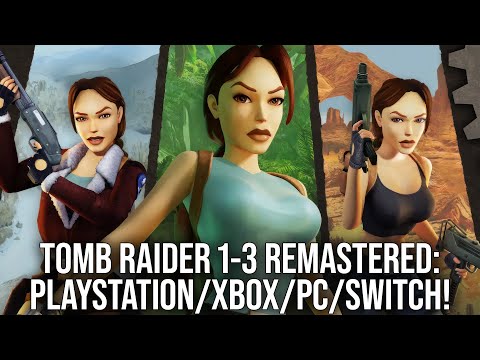
- Tomb Raider 1-3 Remastered - PlayStation/Xbox/PC/Steam Deck/Switch - Digital Foundry Tech Review, Digital Foundry, Feb 13, 2024 (video)
- Tomb Raider: Legacy of Atlantis - The First Preview, IGN, Jun 11, 2026 (video)
Moments
History of Tomb Raider (1996 - 2018)
Nick930
- Tomb Raider (1996) is the game that introduced Lara Croft: a third-person action-adventure by Core Design of Derby…
- Lara began as Laura Cruz, a South American adventurer, then became a British archaeologist, Lara Cruz, and finally…
- Rummery called the breakthrough "the decision to build everything on a grid": it let Gard define Lara's moves, Douglas…
- Her dual pistols have unlimited ammunition; the shotgun, magnums and Uzis need ammunition found in the levels. Enemies…
- Gard and Douglas left Core soon after the release, unhappy with Eidos marketing Lara as a sex symbol and wanting more…
- Tomb Raider: Anniversary (Crystal Dynamics, Jun 5, 2007) rebuilt the game for its 10th anniversary "from the ground…
Was it Good? - Tomb Raider 1
Josh Strife Plays
- Core Design was a studio of around 25 people in a converted Victorian house on Derby's Ashbourne Road in 1994, making…
- In the game's lore Atlantis was ruled by three, Natla, Qualopec and Tihocan, each entrusted with a piece of the Scion…
- The game opens with Natla hiring Lara to recover the Scion from Vilcabamba. After Lara takes Qualopec's piece, Natla's…
- Lara runs, jumps, climbs, grabs ledges, shimmies, swims and dives, with every distance measured in grid squares: a…
- Eidos planned for 100,000 copies; Livingstone said the game sold over seven million, and Eurogamer puts it at 7.5…
Tomb Raider 1-3 Remastered - Before You Buy
gameranx
Tomb Raider 1-3 Remastered - PlayStation/Xbox/PC/Steam Deck/Switch - Digital Foundry Tech Review
Digital Foundry
Tomb Raider: Legacy of Atlantis - The First Preview
IGN
Related
-
 Crystal DynamicsCrystal Dynamics is the California studio that has made Tomb Raider since 2003, from Tomb Raider Legend to the Survivor trilogy. Owned by Embracer Group since 2022, it is making Tomb Raider Legacy of Atlantis with Flying Wild Hog and Tomb Raider Catalyst, both published by Amazon Game Studios.
-
 Lara Croft Spin-offsThe Lara Croft spin-offs are the Tomb Raider games outside the main series, led by the co-op games Lara Croft and the Guardian of Light (2010) and Temple of Osiris (2014), the puzzle game Lara Croft GO (2015), the runner Relic Run (2015) and Tomb Raider Reloaded (2023).
-
Rise of the Tomb RaiderRise of the Tomb Raider (2015) is Crystal Dynamics' second Survivor game, sending Lara Croft to Siberia in search of the Lost City of Kitezh. Critics rated it among the best Tomb Raider games, at 86 on both Metacritic and OpenCritic.
-
Shadow of the Tomb RaiderShadow of the Tomb Raider (2018) ends the Survivor trilogy, with Lara Croft trying to stop a Maya apocalypse in the jungle. Eidos-Montréal led it with Crystal Dynamics; critics liked it less than the two before it, at 82 on Metacritic for Xbox One and 80 on OpenCritic.
-
The Angel of DarknessTomb Raider: The Angel of Darkness (Tomb Raider 6, 2003) was Core Design's last Tomb Raider, a troubled PlayStation 2 and PC game rated 52 and 49 on Metacritic, the lowest of any main-series game. Weeks after it launched, Eidos moved the series to Crystal Dynamics.
-
The Last RevelationTomb Raider: The Last Revelation (Tomb Raider 4, 1999) is Core Design's Egypt game, in which Lara Croft frees the god Set and must imprison him again, and which ends with her apparent death. Metacritic lists no critic score for it, but its users rate it 8.3.
-
Tomb Raider (2013)Tomb Raider (2013) is Crystal Dynamics' reboot, Lara Croft's origin story on a stormbound island, published by Square Enix on Mar 5, 2013 with Camilla Luddington as Lara. It scored 86 to 87 on Metacritic and had sold 11 million copies by 2018, though Square Enix first called its sales below target.
-
Tomb Raider 2Tomb Raider 2 (Tomb Raider II, 1997) is Core Design's first sequel, sending Lara Croft after the Dagger of Xian from the Great Wall of China to Venice, a sunken ship and Tibet. It holds an 85 on Metacritic for PlayStation, one of the best scores in the series.
See also
-
-
Core DesignCore Design was the studio in Derby, England, that created Tomb Raider and Lara Croft, made the first six games from 1996 to 2003 for publisher Eidos, then lost the series to Crystal Dynamics. Toby Gard, credited with creating Lara, left after the first game and returned at Crystal Dynamics in 2004.
-
The ScionThe Scion is the Atlantean artifact Lara Croft hunts in Tomb Raider, split into three pieces found in the Tomb of Qualopec, the Tomb of Tihocan and the Sanctuary of the Scion. Tomb Raider: Legacy of Atlantis builds its story around the same hunt.
-
Tomb Raider: AnniversaryTomb Raider: Anniversary is Crystal Dynamics' 2007 remake of the 1996 Tomb Raider, rebuilt in the Tomb Raider: Legend engine and released first on PC and PS2 on Jun 5, 2007. It scored 83 on Metacritic for PC but sold 1.3 million copies, the series' lowest.
-
-
 Tomb Raider I-III RemasteredTomb Raider I-III Remastered is Aspyr's Feb 14, 2024 collection of the first three Tomb Raider games and their expansions, with new graphics you can switch off at any time, modern or classic controls and a photo mode. It scored 75 on Metacritic for PS5; a Challenge Mode came on Mar 12, 2026.