
 All vikis
 Aion 2
 Ananta
 ARC Raiders
 ArcheAge Chronicles
 Call of Duty: Modern Warfare 4
 Chrono Odyssey
 Civilization 3
 Civilization 4
 Crimson Desert
 Deadlock
 Diablo 4
 Diablo 5
 Enshrouded
 Fable
 Final Fantasy Resonance
 Football Manager 27
 Grand Theft Auto 6
 Heroes of Might and Magic 3
 Heroes of Might and Magic: Olden Era
 Kingdom Come: Deliverance 2
 Path of Exile 2
 Phantom Blade Zero
 Probably Stolen
 Slay the Spire 2
Core Design
Core Design was the studio in Derby, England, that created Tomb Raider and Lara Croft, made the first six games from 1996 to 2003 for publisher Eidos, then lost the series to Crystal Dynamics. Toby Gard, credited with creating Lara, left after the first game and returned at Crystal Dynamics in 2004.
Core Design made the first six Tomb Raider games, from Tomb Raider (1996) to The Angel of Darkness (2003), at its studio in Derby, England, for the publisher Eidos Interactive. In 1994 it was around 25 people in a converted Victorian house on the Ashbourne Road, making 2D games for the 32X and the Atari Jaguar, when Toby Gard pitched a third-person game about raiding tombs. After The Angel of Darkness was poorly received, Eidos moved the series to Crystal Dynamics in July 2003; Rebellion bought Core's staff and assets in 2006, and what was left of the studio closed in 2010.
Quick facts
| Based | Derby, England |
| Publisher | Eidos Interactive |
| Tomb Raider games | 6 main games, 1996 to 2003, plus expansions for the first three |
| Creator of Lara Croft | Toby Gard (with Paul Douglas, in some accounts) |
| Studio head | Jeremy Heath-Smith |
| Lost Tomb Raider | Jul 31, 2003, to Crystal Dynamics |
| Bought by | Rebellion (staff and assets), 2006 |
| Closed | 2010 |
Sources: Eurogamer, Oct 30, 2016; Game Developer, Jul 31, 2003; Game Developer, Jun 16, 2006.
Who created Tomb Raider?
Toby Gard created Lara Croft and came up with the idea of a third-person tomb-exploring game; Eurogamer, interviewing the people who were there, says "everyone agrees" on that despite conflicting accounts of the rest. Gard had designed BC Racers (1994) after Heath-Smith hired him as a teenager; when Heath-Smith asked for 3D ideas that would suit the PlayStation, Gard pitched tomb raiding under pyramids. Some 2004 reports credit Gard and Paul Douglas together with creating Lara.
The original team was six: Gard, programmers Paul Douglas, Gavin Rummery and Jason Gosling, level designer Heather Stevens and artist and level builder Neal Boyd, by Eurogamer's account. Rummery called building everything on a grid "the breakthrough": it let Gard define Lara's moves, Douglas make the controls work, and Rummery write a level editor. Lara's story is told on Lara Croft.
The Core Design games
| Game | Released | Metascore |
|---|---|---|
| Tomb Raider (1996) | 1996 (Saturn first, then PlayStation and PC) | 91 (PlayStation) |
| Tomb Raider 2 | Nov 21, 1997 | 85 (PlayStation) |
| Tomb Raider 3 | Nov 21, 1998 | 76 (PlayStation) |
| The Last Revelation | Nov 22, 1999 | None listed |
| Tomb Raider Chronicles | Nov 24, 2000 | 63 (PlayStation) |
| The Angel of Darkness | Jun 20, 2003 | 52 (PlayStation 2) |
Sources: Metacritic pages for each game, read Nov 1, 2026: Tomb Raider, Tomb Raider II, Tomb Raider III, The Last Revelation, Chronicles, The Angel of Darkness; the expansions as named on Steam. Dates are Metacritic's; the 1996 game's are disputed (see its page). The first three games each got an expansion: Unfinished Business, Golden Mask and The Lost Artifact.
The first game was a far bigger hit than planned: Eidos budgeted for 100,000 units, and it went on to sell over seven million, by Ian Livingstone's account. Core's staff were on royalty contracts, and Heath-Smith said the first royalty check after launch was around £30,000 each. Core then made a new game every year, each now sold in Tomb Raider I-III Remastered and Tomb Raider IV-VI Remastered, which Aspyr built on Core Design's original source code and engine.
Why did Toby Gard leave?
Shortly after the first game, as Tomb Raider 2 was being planned, Gard and Douglas told Heath-Smith they were leaving. Colleagues say Gard was upset at Eidos' marketing of Lara as a sex symbol; in a 1998 interview Gard said they wanted "more extensive control over marketing and PR decisions" and the creative freedom they had had. They founded Confounding Factor in Bristol and made the pirate game Galleon; Gard was 24 and walked away from hundreds of thousands of pounds in royalties. Accounts differ on the year: Eurogamer says shortly after release, and a 2004 GameSpot report points to 1997.
Gard came back to the series in August 2004 as a senior designer at Crystal Dynamics, and worked on Tomb Raider: Legend, Tomb Raider: Anniversary and Tomb Raider: Underworld, helping redesign Lara for Legend.
How Core lost Tomb Raider
The Angel of Darkness, on PlayStation 2 and PC, scored 52 and 49 on Metacritic, the lowest of any main game. Two weeks after Eidos announced that Jeremy Heath-Smith, Core's managing director, was stepping down over its lukewarm reception, Eidos said on Jul 31, 2003 that Tomb Raider would move to Crystal Dynamics in the US. Heath-Smith later said Core had wanted to remake the first game for PS2 instead, but Eidos refused; Core also pitched a PSP remake, and Crystal Dynamics' multi-platform plan, which became Anniversary, got the nod.
In June 2006 Rebellion bought Core's staff and physical assets from SCi, which owned Eidos; Eidos kept the Core Design name and its games, Tomb Raider included. What was left of Core closed a few months before Derby opened Lara Croft Way in July 2010, a name 89% of the public vote chose. The series still goes back to Derby: Crystal Dynamics revealed its 30th anniversary lo-fi album at the TR30 Tomb Raider Day in Derby on Oct 24, 2026.
Frequently asked questions
Who made the original Tomb Raider? Core Design, a studio in Derby, England, made the original Tomb Raider (1996) for publisher Eidos Interactive; Toby Gard created Lara Croft.
Who created Lara Croft? Toby Gard is credited with creating Lara Croft at Core Design; some 2004 reports credit Gard and Paul Douglas together.
Is Core Design still around? No. Core Design lost Tomb Raider to Crystal Dynamics in 2003, Rebellion bought its staff and assets in 2006, and what remained closed in 2010.
Which Tomb Raider games did Core Design make? Core Design made Tomb Raider (1996) and Unfinished Business, Tomb Raider 2, Tomb Raider 3, The Last Revelation, Chronicles and The Angel of Darkness (2003).
Did Toby Gard work on later Tomb Raider games? Yes. Toby Gard left Core Design after the first game, then joined Crystal Dynamics in 2004 and worked on Tomb Raider: Legend, Anniversary and Underworld.
Sources
- 20 years on, the Tomb Raider story told by the people who were there, Eurogamer (Wesley Yin-Poole), Oct 30, 2016
- The history of Tomb Raider, PC Gamer (Nick Thorpe, Darran Jones), Apr 13, 2018, and page 2
- Eidos Transfers Lara Croft To Crystal Dynamics, Game Developer, Jul 31, 2003
- Lara Croft creator rejoining Tomb Raider team, GameSpot (Curt Feldman), Aug 6, 2004
- Toby Gard Returns To Tomb Raider, Game Developer (David Jenkins), Aug 6, 2004
- Rebellion Acquires Core Design Assets From SCi, Game Developer (Jason Dobson), Jun 16, 2006
- Tomb Raider: Legend Turns 20, Crystal Dynamics, Apr 7, 2026
- Everything you Need to Know about Tomb Raider I-III Remastered, Crystal Dynamics, Feb 8, 2024
- Tomb Raider Turns 30! Celebrate with Lo-fi Album & Exclusive Art, Crystal Dynamics, Oct 24, 2026
- Metacritic game pages for the six Core Design games, Metacritic, read Nov 1, 2026
- Tomb Raider I-III Remastered Starring Lara Croft, Steam, read Nov 1, 2026
- History of Tomb Raider (1996 - 2018), Nick930, Sep 7, 2018 (video)
Moments
History of Tomb Raider (1996 - 2018)
Nick930
- The original team was six: Gard, programmers Paul Douglas, Gavin Rummery and Jason Gosling, level designer Heather…
- Shortly after the first game, as Tomb Raider 2 was being planned, Gard and Douglas told Heath-Smith they were leaving…
- The Angel of Darkness, on PlayStation 2 and PC, scored 52 and 49 on Metacritic, the lowest of any main game. Two weeks…
Related
-
 Lara Croft Spin-offsThe Lara Croft spin-offs are the Tomb Raider games outside the main series, led by the co-op games Lara Croft and the Guardian of Light (2010) and Temple of Osiris (2014), the puzzle game Lara Croft GO (2015), the runner Relic Run (2015) and Tomb Raider Reloaded (2023).
-
Rise of the Tomb RaiderRise of the Tomb Raider (2015) is Crystal Dynamics' second Survivor game, sending Lara Croft to Siberia in search of the Lost City of Kitezh. Critics rated it among the best Tomb Raider games, at 86 on both Metacritic and OpenCritic.
-
Shadow of the Tomb RaiderShadow of the Tomb Raider (2018) ends the Survivor trilogy, with Lara Croft trying to stop a Maya apocalypse in the jungle. Eidos-Montréal led it with Crystal Dynamics; critics liked it less than the two before it, at 82 on Metacritic for Xbox One and 80 on OpenCritic.
-
The Last RevelationTomb Raider: The Last Revelation (Tomb Raider 4, 1999) is Core Design's Egypt game, in which Lara Croft frees the god Set and must imprison him again, and which ends with her apparent death. Metacritic lists no critic score for it, but its users rate it 8.3.
-
Tomb Raider (2013)Tomb Raider (2013) is Crystal Dynamics' reboot, Lara Croft's origin story on a stormbound island, published by Square Enix on Mar 5, 2013 with Camilla Luddington as Lara. It scored 86 to 87 on Metacritic and had sold 11 million copies by 2018, though Square Enix first called its sales below target.
-
Tomb Raider ChroniclesTomb Raider Chronicles (Tomb Raider 5, 2000) is Core Design's fifth game, four short flashback adventures told by Lara Croft's friends at her memorial after The Last Revelation. It scored 57 to 63 on Metacritic, and its PC version came with the Tomb Raider level editor.
-
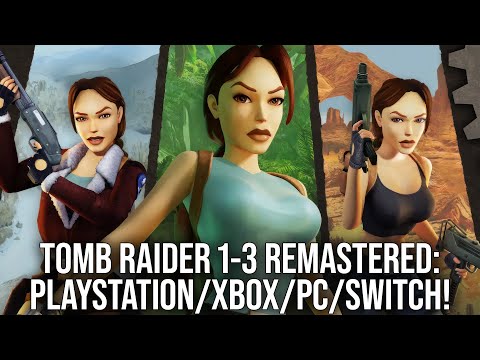 Tomb Raider I-III RemasteredTomb Raider I-III Remastered is Aspyr's Feb 14, 2024 collection of the first three Tomb Raider games and their expansions, with new graphics you can switch off at any time, modern or classic controls and a photo mode. It scored 75 on Metacritic for PS5; a Challenge Mode came on Mar 12, 2026.
-
 Tomb Raider IV-VI RemasteredTomb Raider IV-VI Remastered is Aspyr's Feb 14, 2025 collection of The Last Revelation, Chronicles and The Angel of Darkness, with switchable new graphics, modern controls and an expanded photo mode. Critics were lukewarm (69 on OpenCritic), players warmer (89% positive on Steam), as of Nov 2, 2026.
See also
-
Tomb Raider (1996)Tomb Raider (1996) is the first Tomb Raider game, made by Core Design in Derby and published by Eidos Interactive in late 1996 on Sega Saturn, PlayStation and PC. Lara Croft hunts the Scion across 15 levels in Peru, Greece, Egypt and Atlantis; it sold over 7 million copies.
-
The Angel of DarknessTomb Raider: The Angel of Darkness (Tomb Raider 6, 2003) was Core Design's last Tomb Raider, a troubled PlayStation 2 and PC game rated 52 and 49 on Metacritic, the lowest of any main-series game. Weeks after it launched, Eidos moved the series to Crystal Dynamics.
-
 Crystal DynamicsCrystal Dynamics is the California studio that has made Tomb Raider since 2003, from Tomb Raider Legend to the Survivor trilogy. Owned by Embracer Group since 2022, it is making Tomb Raider Legacy of Atlantis with Flying Wild Hog and Tomb Raider Catalyst, both published by Amazon Game Studios.
-
-
Tomb Raider 2Tomb Raider 2 (Tomb Raider II, 1997) is Core Design's first sequel, sending Lara Croft after the Dagger of Xian from the Great Wall of China to Venice, a sunken ship and Tibet. It holds an 85 on Metacritic for PlayStation, one of the best scores in the series.
-
Tomb Raider 3Tomb Raider 3 (Tomb Raider III: Adventures of Lara Croft, 1998) is Core Design's third game, in which Lara Croft tracks four artifacts carved from an Antarctic meteorite through India, Nevada, the South Pacific and London. It scores 76 on Metacritic and is the longest classic Tomb Raider to finish.